For businesses, tokenization is not an abstract technology, but a concrete product launch. That is why the focus shifts from the technology itself to how to build a working system for going to market.
For one project, it may be enough to bring the first tokenized asset to market quickly and test demand. Another will need a branded platform, a smoother user journey, and card payments. A third may require a full product: a marketplace, marketing strategy, payment infrastructure, and operational support.
The difference is easy to see in the three solutions from the Sabai Protocol tokenization platform: Starter, Optimal, and Enterprise. Each one is built for a different launch stage, with its own timeline, cost, and level of provider involvement.
What a Tokenization Solution Usually Includes
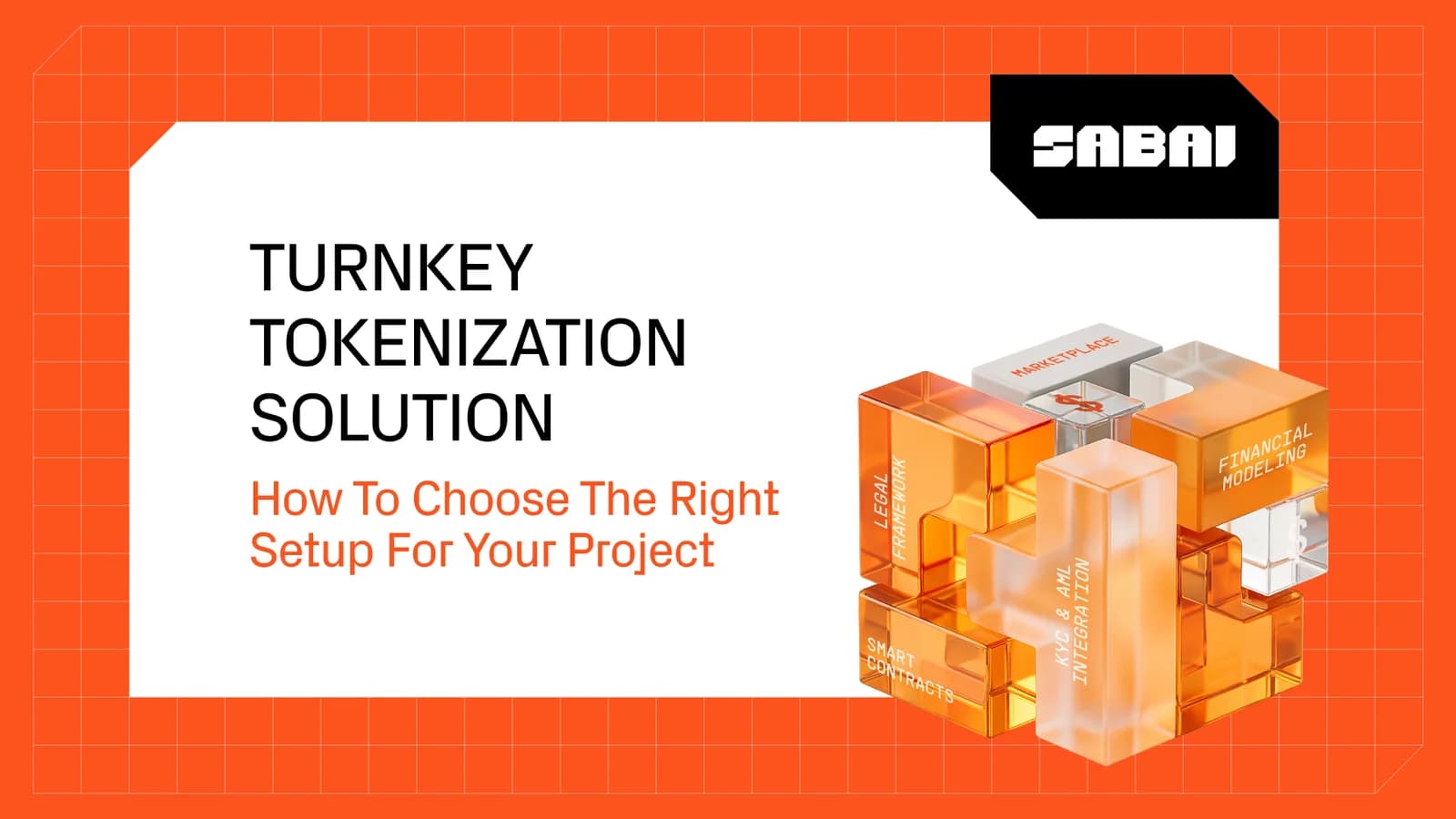
A complete tokenization solution is built from several parts: legal structure, technical platform, payments, user verification, marketing, financial model, and operational support.
The tokenization legal framework defines who owns the asset, who issues the tokens, what rights the buyer receives, how payouts work, what restrictions apply to token transfers, and which documents regulate the structure.
The technical infrastructure turns this model into a working platform. It includes smart contracts, backend infrastructure, buyer dashboard, admin panel, integrations, and deployment to a live environment.
The payment block defines how users pay and withdraw funds: through cryptocurrency, bank cards, local payment methods, or bank accounts.
For more complex launches, the solution may also include a financial model, marketing strategy, brand identity, branded marketplace, wallet screening, team support, and setup of operational processes after launch.
The important point is that not every business needs all of these blocks from day one. Sometimes it makes more sense to start with the basic infrastructure, test demand, and expand later. In other cases, a basic launch is not enough because the company is building a separate business line from the start.
That is why Sabai Protocol has divided its solutions into three packages: from a fast basic launch to a full turnkey product.
Starter: Basic Launch
Timeline: 2–4 weeks
Cost: from $24,000
Starter is designed for businesses that need to launch their first tokenized asset quickly, without deep customization, long development, or complex setup. It provides the basic legal and technical infrastructure needed to start.
This format makes sense when a project already has a clear asset, a simple tokenization model, and an initial audience to test demand. For example, a developer can tokenize one property and check interest among an existing buyer base. Another company might use it to launch a minimal platform, onboard the first users, and see how the process works in practice.
Starter includes:
- legal structure for tokenization;
- smart contract deployment;
- backend setup;
- user dashboard;
- admin panel;
- KYC integration;
- platform launch and license.
This package uses a ready-made platform base that can be adapted to the project. It is not custom development from scratch, but a standard solution prepared for a faster market launch.
The user dashboard covers the basic buyer journey: registration, KYC, wallet connection, asset overview, token purchase, and transaction tracking. The admin panel helps the team manage users, verification statuses, assets, transactions, token allocation, and reporting.
Starter is a good fit when the goal is not to build a large marketplace, but to quickly launch working infrastructure for the first asset. Marketing, sales, user acquisition, and card payment integration remain on the client’s side. Sabai provides the legal and technical foundation, while the business is responsible for bringing in buyers and selling the product.
Optimal: Extended Solution with Customization
Timeline: 4–6 weeks
Cost: from $49,000
Optimal is designed for businesses that need more than basic infrastructure. It adds a branded product interface, a smoother user journey, and access to card and local payment methods.
This package includes everything in Starter, plus:
- custom interface in the client’s brand;
- deposit and withdrawal setup through Melt;
- 40 hours of consulting from the Sabai team.
The main difference between Optimal and Starter is that the product starts to look like the client’s own platform. This matters when a company plans to bring users from ads, partner channels, newsletters, communities, or private sales.
Interface development includes adapting the design, page structure, navigation, and content to the client’s brand. This is not just a technical dashboard, but a cleaner user environment where buyers can better understand the product and move through the purchase process.
This is also where payment infrastructure comes in. Deposit and withdrawal setup through Melt helps projects work not only with crypto-native users. Buyers can purchase and withdraw cryptocurrency using bank cards and local payment methods.
For many projects, this is a key point. If a buyer is not used to crypto wallets, a complicated payment flow can become a reason to drop off. The easier the entry point, the fewer barriers there are between interest in the asset and the actual purchase.
The 40 consulting hours are used for launch and implementation. The Sabai team helps with platform settings, workflows, user verification, payment logic, and operational questions.
Important note: the standard Optimal package does not include a marketplace, financial model, marketing strategy, or SEPA banking infrastructure.
Optimal fits businesses that are ready to show the product to the market, but are not yet building a full marketplace with a marketing strategy and extended infrastructure for larger deals. When they get there, the full scope of turnkey tokenization services comes into play.
Enterprise: Full Turnkey Product
Timeline: 3–6 months
Cost: from $224,000
Enterprise is not about quickly launching one asset. This package is for projects that treat tokenization as a separate business line.
In this format, a technical platform is only one part of the launch. The company also needs the full product system around it: marketplace, payment infrastructure, financial model, marketing strategy, operational processes, and team support.
Enterprise may be suitable for a developer with several properties, a manager launching tokenized funds, a commodity project, an infrastructure company, or a business planning to enter several markets.
Enterprise includes everything in Starter and Optimal, plus:
- brand identity and custom interface;
- marketplace;
- KYC and AML screening of crypto wallets;
- SEPA setup;
- financial model;
- marketing strategy;
- 100 hours of consulting.
With this package, Sabai helps build not separate tools, but a complete system for going to market. With this package, Sabai helps build not separate tools, but a complete system for going to market. One example of this in action is tokenized real estate on Sabai Property: a project where the full scope of services came together — from legal structure and marketplace to payments, user and wallet screening, and operational sales support.
A marketplace is needed when the project works with multiple assets and has to present them clearly to buyers. For real estate tokenization compliance, KYC and AML wallet screening help reduce risks and detect sanctions exposure, suspicious transactions, and the origin of funds. SEPA setup adds a bank transfer route for larger payments and makes the payment flow more familiar for international buyers.
The financial model helps calculate the product economics in advance: revenue, fees, fund flows, payout logic, reserves, and scenarios for buyers or partners.
The marketing strategy defines how the product will enter the market: which positioning to use, which audience to focus on, what messages to communicate, which channels to use for buyer acquisition, and how to take legal and compliance limits into account in public communication.
Enterprise does not mean that the provider handles direct sales instead of the client. Its role is to prepare the product, infrastructure, marketing foundation, and operating model so that the business can enter the market with a ready system, not a set of disconnected tools.
If the goal is simply to test one asset and the product model has not yet been validated, Enterprise may be more than the project needs. In that case, it is usually more logical to start with Starter or Optimal and expand later.
Full Launch Example: RENANCE Case Study
One of our cases, RENANCE, shows what a full-scale tokenization product launch can look like. Sabai Protocol helped launch the project in 6 months: from product structure and financial model to marketplace, user dashboard, admin panel, and payment processes.
RENANCE was not created as a test for a single asset. It was built as a full platform for investing in tokenized real estate across Asia. That is why, in addition to technical infrastructure, the project also required brand development, identity, design, and marketing strategy.
The goal was not just to issue tokens. It was a full tokenized asset marketing launch: the product had to be packaged for an international audience, present properties clearly, explain the participation model, build trust, and guide users from the first touchpoint to purchase.
At launch, the platform listed three properties with a total value of $796,300. RENANCE is designed to add more properties from different developers across Asia over time.
This case shows when a basic launch is no longer enough. If a business is not building a one-off deal, but a full sales channel for tokenized assets, it needs a marketplace, financial logic, payment infrastructure, marketing packaging, and an operating system around the product.
You can also read the full RENANCE case study: it explains what work was done, what the launch included, and how the platform development process was structured.
Conclusion
The right choice does not depend on the number of features or the size of the company. It depends on the stage of the project and the task the business needs to solve now.
If the goal is to quickly test demand for one asset, basic infrastructure is enough: legal structure, smart contracts, user dashboard, admin panel, and KYC. Starter is designed for this format.
If the project already has an audience, acquisition channels, and a need to launch the product in its own brand, the user journey becomes more important: custom interface, clear navigation, trust in the platform, and convenient payments through cards or local methods. In this case, Optimal is usually the better fit.
When tokenization becomes a separate business line, a technical launch alone is not enough. The project needs a marketplace, brand identity, financial model, marketing strategy, extended user and wallet checks, banking infrastructure, and operational support. Enterprise is built for this format.
If you are not sure which package fits your project, we can run a free diagnostic: review the asset, business model, payment needs, platform requirements, and go-to-market goals.