Why Tokenized Assets Are Gaining Attention
Not long ago, real estate, infrastructure funds, and commodity markets were out of reach for anyone investing small amounts: a large ticket, closed offerings, complex legal structures.
Tokenization changes that. A real asset — or the right to income from it — is split into digital fractions, and the entry threshold drops sharply. Now you can access real estate, gold, credit products, renewable energy, or funds through an online platform — without buying the whole object.
But that doesn't make the asset risk-free. What changes is only how you access it, how ownership is recorded, how payouts are made, and how you exit. The risk itself still depends on what stands behind the token.
In this article we break down the main categories of tokenized assets: their potential returns, growth drivers, and the risks worth understanding before buying.
What Tokenized Assets Actually Are
Before going further, it's worth separating tokenized assets from cryptocurrency. Bitcoin and similar coins are purely digital — they have no underlying real-world asset. Tokenized assets are different: the token represents a claim on something real, whether that is a property, a loan, a gold reserve, or a fund.
When you buy a tokenized asset, you are not always buying a physical share of the object itself. More often, you are acquiring rights defined by the specific project — the right to income, fixed payouts, participation in value appreciation, a buyback arrangement, or another structure. The token is the container; what matters is what is inside it.
Before buying any tokenized asset, the key questions to ask are:
- what real asset backs the token
- what rights the buyer actually receives
- whether there is a legal structure in place
- how the return is calculated
- who manages the asset
- what exit options are available
Real Estate — One of the Most Intuitive Tokenized Assets
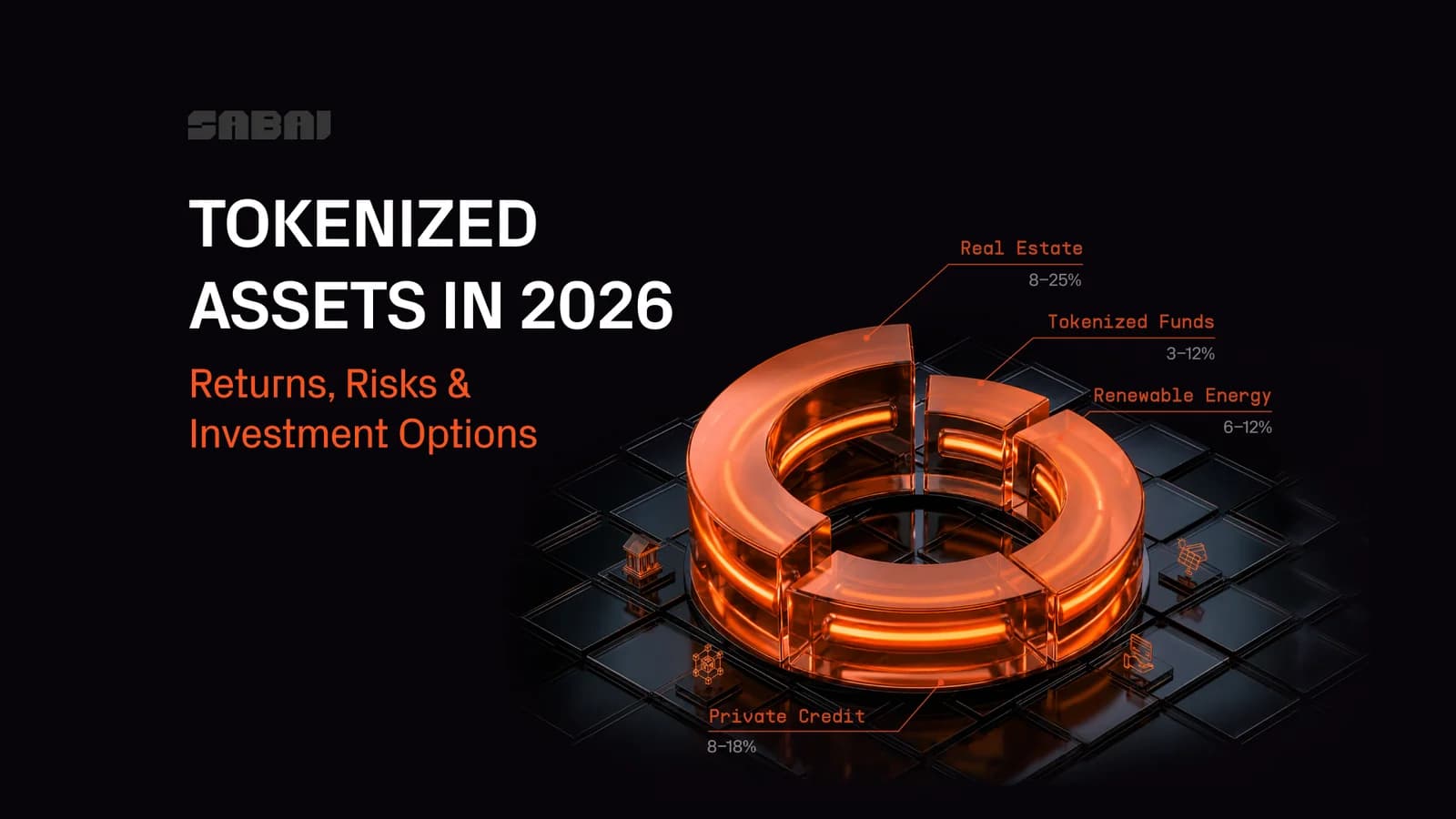
Indicative return: 5–25% per year
Real estate is one of the easiest asset classes to understand in tokenized form. Behind the token might be an apartment, a commercial unit, a hotel room, or a development project. Normally, entering real estate requires significant capital and direct involvement in purchase, registration, renovation, and tenant management. Tokenization allows participation with a smaller check and without handling the operational side.
Returns in tokenized real estate depend on the specific object and the participation model. Some projects generate rental income distributed to token holders. Others offer a fixed annual rate of return, returns tied to property value growth, a buyback schedule, or revenue from operating the property.
What drives returns is not just the fact of tokenization — it is the quality of the underlying asset. Location, rental demand, neighborhood development, the condition of the object, and the developer's track record all matter. A clear legal structure and the availability of a secondary market for the tokens also significantly affect how the investment actually performs.
Real estate is considered a tangible asset, but tokenization does not eliminate its risks. The property may not appreciate as expected, rental income may fall short of projections, construction can be delayed, and selling tokens quickly is not always possible. The terms depend entirely on the legal structure of the specific project.
Tokenized Treasuries — The More Conservative End of RWA
Indicative return: 3–5% APY (Annual Percentage Yield)
Tokenized Treasuries are products linked to short-term U.S. government bonds or money market funds. This is one of the most conservative segments of the RWA market because the underlying asset is tied to U.S. sovereign debt.
For a private investor, this category may be interesting as a quieter option compared to real estate, private credit, or development projects. Returns tend to track short-term U.S. Treasury yields or money market fund rates and depend on interest rate levels, fund structure, fees, and the specific product.
These products became more popular alongside broader interest in real-world assets and on-chain yield products with conservative profiles. They allow investors to keep capital in digital form while staying anchored to traditional financial instruments.
Despite their conservative nature, these products still require careful evaluation. Returns move with interest rates, products may not be available in all jurisdictions, and the tokenized wrapper does not remove the risks of the underlying financial instrument. Platform and fund fees can also affect the net return.
Gold and Commodity Assets — Digital Access to Familiar Markets
Return: not fixed — depends on the price movement of the underlying asset
Gold and other commodity assets have a market price that can be tracked, which makes them intuitive for many investors. Tokenized versions can include gold, silver, oil, or industrial metals.
These assets generally do not produce a regular yield. Returns — or losses — come from changes in the price of the underlying commodity. If a token is tied to gold and the gold price rises, the token value may rise with it. If the price falls, the token loses value too.
Gold is often viewed as a defensive asset — a store of value in times of inflation or geopolitical uncertainty. Industrial metals tend to move with manufacturing cycles, infrastructure demand, and energy trends. The growth drivers for commodity-backed tokens typically include inflationary expectations, demand for safe-haven assets, industrial consumption growth, and supply constraints.
The main risk here is price volatility of the underlying asset. Beyond that, investors should understand whether the token is genuinely backed by a real physical asset, who holds that asset in custody, and how the backing is verified. Liquidity on secondary markets for commodity tokens can also vary significantly.
Renewable Energy and Infrastructure
Indicative return: 6–12% per year
Tokenization can be applied to solar farms, wind projects, charging stations, telecom infrastructure, logistics facilities, and other projects with real operating revenue. For investors, this can be a way to participate in energy and infrastructure assets that would otherwise require institutional-level access.
Returns in this category depend on the project model. Payouts may be tied to energy sales, long-term contracts, green certificates, infrastructure leasing, or fixed scheduled distributions. The drivers behind this segment include growing demand for renewable energy, infrastructure development, government support for green projects, long-term offtake contracts, ESG interest, and the need for alternative financing in the sector.
This market is less standardized than real estate or private credit. Projects vary widely in structure, risk profile, and transparency. Construction or launch delays are possible, revenue may underperform projections, and regulation can shift. Infrastructure projects often require a longer time horizon, and liquidity may be more limited than in more mainstream asset classes.
Private Credit — Tokenized Loans and Debt Products
Indicative return: 8–15% APY; in higher-risk segments up to 18% APY
Private credit involves investors participating in the financing of companies, projects, or specific loans. In tokenized form, these instruments can be divided into smaller fractions, making them accessible to a broader range of investors.
This is one of the higher-yield categories — and one of the higher-risk ones. Income is generated through interest on loans or debt instruments. The investor effectively gains access to a credit product where the return depends on the borrower, the loan term, collateral quality, the platform's risk model, and the rigor of underwriting. Structures can include corporate debt, invoice financing, structured credit, or direct lending.
Private credit is growing as a market because businesses often need more flexible financing than banks provide. Tokenization can make these products more accessible and simplify how participation, payouts, and compliance are managed — partly through smart contracts.
Before entering this category, careful due diligence is essential. Borrowers may default, collateral may be weaker than it appears, and high yields frequently reflect high credit risk. Documentation can be complex, and liquidity is often limited.
Tokenized Funds and RWA Baskets
Indicative return: 3–12%+ per year
Tokenization can also be applied to funds or portfolios rather than single assets. These may be real estate funds, private credit funds, Treasury products, mixed RWA baskets, or yield-generating portfolios. For an investor, this format offers exposure to multiple asset types within a single product — a practical way to diversify with a smaller check.
Returns depend entirely on what is inside the fund. A portfolio of tokenized Treasuries may yield closer to 3–5% per year. One concentrated in private credit or real estate may target 8–12%+. But higher potential return generally comes with higher risk.
The appeal is convenience and diversification. The trade-off is that investors are dependent not just on the underlying assets but also on the manager's strategy and decision-making. Understanding what is actually inside the portfolio, what fees the platform charges, and how transparently performance is reported are all critical before committing capital.
Which Assets Suit Different Investor Profiles
For a more conservative approach — Tokenized Treasuries, money market products (short-term, low-risk holdings with modest returns), gold. Expected return: 3–5% per year for Treasuries; for gold, no regular yield, with return depending on price movement.
For those who want a tangible, understandable asset — Tokenized real estate. Expected return: 5–25% per year, depending on the object and structure.
For those seeking regular income — Private credit, rental real estate, infrastructure projects. Expected return: 6–15% per year, with risk depending on the borrower, project, or underlying asset.
For those willing to accept more risk in pursuit of growth — Real estate under construction, renewable energy, select commodities. Returns may be higher but are less predictable and often depend on asset appreciation or a successful project exit.
For those who want diversification — Tokenized funds and RWA baskets. Expected return: 3–12%+ per year, depending on portfolio composition.
Conclusion
Tokenized assets are becoming a bridge between real markets and digital investment platforms. They can be interesting for investors who want to start with a smaller entry point, diversify a portfolio, or access real estate, Treasuries, private credit, commodities, renewable energy, or other asset classes online.
But the core principle stays the same: high returns do not exist without risk. Before buying, it matters to understand what backs the token, what rights the investor receives, how income is generated, and whether there is a realistic path to exiting the position.
For most private investors, the most intuitive categories remain real estate, tokenized Treasuries, gold, and private credit. Real estate in particular works well as an entry point into tokenization — because behind it sits a real object, a clear value logic, and several possible income models.